Sunday, July 31, 2011

Puno...eh

There seems to be a lot of "est" in Peru. Deepest canyon, the most pristine rainforest, largest high-altitude lake, Lake Titicaca next to Puno. As a town nestled atop a hill 3800m above sea level and next to a large lake, Puno is a freezing destination. And it did NOT help that my budget hostel had no heating, no insulation, and worst of all, no hot shower. I knew this was going to be a short visit. Hell, on the 2nd night, I had to resort to sleeping with all of my clothes on and holding a large bottle filled with hot water.

Most people generally make a stop in Puno to visit the 3 islands on Lake Titicaca. I did a tour of 2 of them - Isla Uros and Isla Taquile. The first is the famed floating islands. But unlike the legit floating islands in Cambodia, where people actually live and are self-sustained, the people on Uros are just for show. All they do is wait for tourists to come and show their merchandise that could be bought anywhere in Peru. The Isla Taquile was much more worthwhile, as a UNESCO World Heritage site should be. These islanders live by fishing and agriculture, but their claim to fame is their textile weaving, which apparently is on par with the best in the world. It was a true pleasure to watch the men and women neatly and precisely weave with 5 needles.


Aside from the islands and the cheap food, Puno serves as a hop on, hop off point for Cusco or Bolivia. For me, I was headed northward - to the capital of the Incas, Cusco!

- Ryoji

Friday, July 29, 2011

Great city, greater people

So I arrived at the Arequipa bus station, and the Lonely Planet warned about how corrupted the taxi drivers in this city are. I knew I had to be careful. The area around the station was a mess. Dirty, noisy, run-down. Regrettably, I hailed a cab (I always like to walk) to the city center, Plaza del Armas. And helllooooo Peru! The town center (aka tourist hub) was absolutely gorgeous! Large, white colonial buildings surround the plaza, and it's rightfully called the White City. I also booked a hostel near the bar district, right by the center called Wild Rover. I would recommend this hostel for anybody going to Arequipa, Cuzco, or La Paz.


I met some peeps in my room and at the bar in the hostel. As a huge tourist country full of backpackers, it was rather easy to meet people here. Actually, it really reminded me of Thailand. Many people in both countries fly in and out without venturing farther because of either time constraints or that country is just THAT awesome. But they're both countries steeped in rich, interesting history, great parties, and cheap! Compared to Argentina and Chile, I thought that the travelers in Peru are crazier and more about having fun.

After 2 nights of going out, it was time for Colca Canyon! Oh wait, backtrack. With some people I met from th nights before, we had a nice lazy sunday afternoon. I really need to recommend the Ice Princess, Juanita, museum. The Incas used to sacrifice virgins on top of 6000m mountains to appease the mountain gods. One of the most well preserved virgins is on display at this museum with all of the offerings around her in the sacrificial cave. A well spent 20 S./

But this really makes me think about the ethics of archeology. Of course, I appreciate the information, and it is very interesting to go to a museum full of artifacts and mummified bodies. But who are we to dig up these sacrifices to the gods - it clearly was not their purpose. Is it right for us exploit these centuries old culture for our sake?

Well, anyways, after a looong coffee break and a stroll around town, we went for a cerviche, a classic Peruvian dish. Raw fish, seafoods, mollusks, yam, maize, drizzled with lime and onions. Kind of like sour sashimi.


Ok, so th 2 day, 1 night Colca Canyon trek. It's the deepest canyon in the world at 3191m deep, twice as deep as the Grand Canyon. The only question I have is - what is the distinction between canyons, valleys, gorges, etc? Because this one seemed more like a valley. But in any case, it was beautiful, saw a lot of Andean condors, the biggest birds in the world, met some nice people, with whom I went clubbing after the trek.


By the time I finished the trek, I had already been in Arequipa for 5 days, and as nice as the place is, it was time for me to get a move on. Next stop: Puno.

- Ryoji

The driest desert in the world

Sitting 2500m above sea level, the Atacama desert is known to be the driest desert in the world. And most fittingly, it is the site of the largest telescope in the world. San Pedro de Atacama, an oasis in the middle of the desert, is a nice 24 hour bus ride away from Santiago. But having traveled quite extensively, 24 hour bus ride just doesn't faze me anymore, it's actually quite nice to sit back and do nothing for awhile. Well, it's actually not the doing nothing part that's great, but more of the fact that I CAN'T do anything part that's a relief when traveling. Just read, listen to music, sleep, repeat.

I arrived at this tiny village at noon, and man, was it touristy! I guess an oasis attracts travelers. I had come to this place just to chill and absorb the great expanse of the desert. I got myself a small, rather bleak single room on the main road. As soon as I put my bag down, I rented a mountain bike - sunscreen in one hand, water bottle in the other.

I set out for a 12th century fortress ruins that were a few km on the outskirts. Traveling on a half stone/half sand path, I was really worried that the tires would punctures in the middle of the desert, leaving me to face the terrifying consequence of naure. On the other hand, it's hard to worry when surrounded by other-worldly scenery, as all you can do is stare and admire. Similar to the time on Easter Island, you can't help but to feel the insignificance of the human race.


The next day, I signed up for a tour of the Salar de Atacama (Atacama Saltflats) and a small traditional pueblo (village). This was my consolation prize as I had to give up going to Bolivia and its (apparently) beautiful Salar de Uyuni because as an American, I need to pay a $160 reciprocity fee (as in, a fuck you America fee) and a yellow fever vaccination certificate that I did not have. Salar de Atacama was interesting enough, quite different from the salt flats n Utah or the pictures I've seen of Salar de Uyuni as it is much drier in Atacama. The main tourist attraction was definitely the 3 species of flamingoes that nest in the area. Outside o zoos, this was the first time I had seen these elegant creatures. And all I could think was how their bodies can possibly be supported by those sticks called "legs." I was absolutely mesmerized.


The tour didn't take long, and I felt like I had accomplished most of the things I wanted to do in San Pedro de Atacama - desert and salt flats - so I got on the overnight bus to Arica, then Tacna (a Peruvian border town), and finally to Arequipa in Peru, all in one day just to make it to Arequipa's supposedly wild nightlife on a Friday night!

- Ryoji

Graffiti & Mugging

Valparaiso is a beautiful port town 2 hours northwest of Santiago. It's famous fr its 40-something hills and colorful architecture, often decorated by professional graffiti artists (at least I think they were professional).


But it will forever be remembered as the first place (and hopefully the last) that I got mugged by knife point.

So let's backtrack. Valparaiso is a kind of city that wanderers dream of. Every street, alleyway, every hourse, they are a marvel - no wonder it's a UNESCO World Heritage site. So a Swedish guy I met at the hostel and I, this is exactly what we were doing. But unfortunately, he was carrying his large expensive-looking camera around his neck, and 3 young hoodlums with tiny knives (still, knife is a knife) came to mug us. My first instinct was to run, so I did. And I knew that I could outrun most people. But my friend froze up and had his camera snatched away from him. And then, just like that, the hoodlums were gone.

It definitely made me realize that South America is more dangerous than other countries, and I need to be more vigilant. And now, I only carry around a few bucks with me when I go out. No camera, no iPod, no debit card.

BUT, I really don't want this to deter anybody from coming to South America or Valparaiso as it is still a beautiful place.

- Ryoji

An island that should be on everybody's bucket list

3000 km west of Chile lies this small island, Rapa Nui, or more commonly known as Easter Island to most people as it was "discovered" on Easter Sunday. Famed for its gigantic Moai statues, the island attracts tourists that come to marvel at the remarkable mysteries dotting the island.


As soon as I stepped off the airplane, I could just smell the difference in the air. And compared to mainland Chile, it must've been 5 - 10 degrees warmer and perfectly sunny. I was welcomed by the hostel with a lei and a cup of freshly squeezed orange juice at the airport! That alone made the trip worth it. The short tour of the town square ended in about 2 minutes - 2 banks, some small food stores, one museum, a few internet cafes - and that was it. I fortunately had a dorm room to myself. Perfect for a chill island like this.

On the first day, I booked my full day tour to the famous sites, and I visited the museum of Rapa Nui, as an introductory course since I knew very little about the culture. As I found out in the subsequent days, this island was formed when 3 nearby volcanoes connected over the years. It was first inhabited by Polynesians centuries ago, and these people built these Moai statues for ancestral worship. Each statue is one generation of the clan, which were scattered throughout the island.

A half day bike trip, along the Western coast and up the volcano was incredible, save the weather. Since it's in the middle of the ocean, the wind is quite strong, and this brings about unpredictable weather. I thought I was back in London! The Rano Kau volcano is famous for its crater lake and the Orongo village, where people performed the birdman ceremonies. This religion took over after people stopped creating Moai statues and celebrating their ancestors. As the culture shifted towards this religion, a very interesting ceremony was born: A native bird to Rapa Nui nests its eggs on this tiny island on the coast of Orongo village. Numerous men risk their lives to be the first one to fetch the egg and return to the Orongo village, where he is celebrated as a hero. In this village, one can see the petroglyphs of their god, Make-Make carved in stone. Nearby, one can also see colorful cave paintings of birds.


The last day was the tour day. I was picked up in a van early in the morning to go visit the sites of Ahu Akahanga, Anakena, among others. The first one is arguably the most impressive site with 15 standing Moais, thanks to the Japanese government. On Anakena stands 3 Moais on the backdrop of a beautiful beach, one of only 2 on the island. We also visited the other volcano, Rono Raraku, where the moais were dug in the quarry. You can still see the unfinished Moais in the quarry, a clear indication of how these gigantic statues were made.


Although I was the only English speaking person on the trip, I befriended some French people, which made me really miss speaking French. That last night, I headed to a restaurant that was showing a traditional Rapa Nui dance, which was quite a spectacle.


Although it's been the highlight of the trip so far, the only negative of the island was the price. Everything was comparable to Swiss prices, even for the locals because everything needs to be imported from the mainland. And LAN airlines has a monopoly for the flights so it's quite expensive to get there as well.

I would still say that people that love culture and history should visit this place at least once in their lifetime.

- Ryoji

Thursday, July 21, 2011

4300 km in length, 200 km in width, welcome to Chile

Protected by the Andes to the East and isolated by the Pacific to the West, Chile's geography is more like that of an island. And since it stretches so far south-north, the country provides the bone-chilling Patagonia in the South as well as the drist desert in the world up north.

Arriving in Santiago, it's easy to see why it's the most developed and unfortunately, expensive country in South America. An army of towering skyscrapers line the orderly streets while businessmen hurry in and out of buildings. Universities are on every street corner, and I got a sense that it really is a young city. Especially because I was staying in an area known to be the university/bohemian/party district.
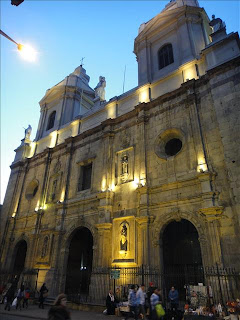


As soon as I got on the metro to go to my hostel, I was approached by a guy from Alaska, mostly because I was carrying my Lonely Planet guide in my hand. An easy give-away. So just like that, I had my go-to guy for the next 2 days before my flight to Isla de Pacqua or Rapa Nui or Easter Island. The guy was staying in a hostel very close to mine so we decidedto meet up for dinner that night. We went to a grundgy little place, and I ordered my first (and probably the last) Chorrillana! It's beef, sausage, chicken, caramelized onion, and 2 eggs on a bed of french fries. It's heart attack city. As great as it is while eating, you can't help but to regret it after. It is the best pub grub though.

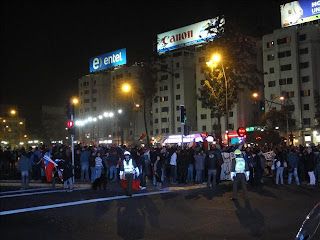
And since I arrived in South America, the Copa America (soccer tournament) has been going on, and Chile was playing Bolivia that night. Fortunately, they won. I say fortunately because the city was in an uproar of frenetic celebration. Zealots honked their car horns relentlessly, and even the police seemed to be having a good time.


As a city, I thought it was much more manageable than Buenos Aires. And it definitely helped that I did the free walking tour the first day. I learned about the city's history, the indigenous people, quirky facts, but one institution absolutely blew my mind: coffee with legs. Apparently, because the coffee in Chile was so bad years ago, coffee shops needed a way to sell this shit drink. Someway, somehow. So this guy came up with the ideato have cladly dressed women be their waitresses. No chairs, just tables. And of course, it became a huge hit. Nowadays, these coffee with legs dot the business district, and men in suits frequent the place during business hours (it's closed at night). But seriously, some of these places literally look like a club - with light up floors and discoballs.
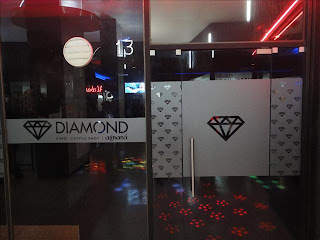
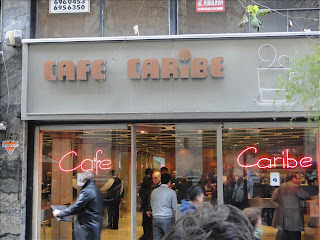


...and apparently if the customers are lucky, the girls briefly shut the curtains and flash everybody inside.

Also afterthe walking tour, my group wentto a popular Chilean restaurant to try some Pastel de Chocle, Parrilladas, and bottles of Carmenere wine. The first dish is a corn pie stuffed with chopped beef, other meats, and onions. The second is a meat bucket of chorizo, ribs, steak, pork chop, blood sausage, etc etc. But I had to really hurry to catch my winery tour!

Instead of cheaply going by myself, I stupidly decided to do a tour of Cocha y Toro. It's one of the biggest in the world and probably one of the most well known in South America. The tour through the vineyards and the cellar was interesting enough, and the 2 glasses of fine wine helped me cope with the money foolishly spent. Well, at least I got one winery tour while in Argentina or Chile, two big wine countries.


And after an eventless night, I woke upat 4 am to head to the Santiago airport. I was off to the midle of the Pacific!!

- Ryoji

The Iguazu Dilemma

Apparently it's a place that one must see before dying. It's breath-taking and worth the whole South American trip.

But I didn't go.

Why? Mostly due to time constraints and money. A round trip ticket by flight costs about $400 from BA. A round trip bus ticket costs about $200, and it takes 24 hours one way. And if I had gone after BA, I would've had to spend Friday and Saturday nights in a small town.

So in the end, it just didn't seem worth it, and I like to say that I'll come back to it later in life. So we'll see. If anybody wants to go see this natural wonder with me, hit me up.

And now... off to Chile!!

- Ryoji